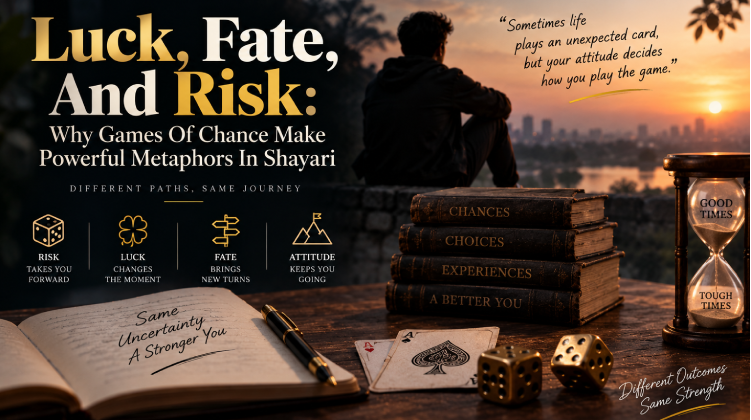
Shayari can turn a complex feeling into one sharp image.
A road can stand for choice. A storm can suggest hardship. A locked door can represent rejection. In the same way, luck, fate, and risk give poets a compact language for uncertain moments.
These ideas fit shayari because life rarely follows a clean plan.
Love may begin through an unexpected meeting. A trusted relationship may change overnight. Hard work may bring success, or circumstances may delay it. People make decisions without knowing exactly where those decisions will lead.
Games of chance provide familiar metaphors for this uncertainty.
A changing result can represent fortune. A bold move can stand for courage. Winning and losing can describe emotional highs and lows without referring to a literal contest.
The metaphor becomes especially powerful when poets place fate beside personal choice.
A person cannot control every event, but they can still decide whether to wait, leave, forgive, try again, or change direction.
That tension gives shayari movement.
Chance describes what may happen. Risk describes the choice to act. Fate gives the outcome a larger meaning.
Together, these ideas let a few lines carry a much larger emotional story.
Risk Gives Shayari A Language For Difficult Choices
Risk becomes meaningful when a person must act without knowing the result.
Shayari often captures this moment in love, friendship, work, and personal change. A speaker may confess a feeling, leave an unhealthy bond, or follow an uncertain path. Each choice opens one door while closing another.
That structure resembles a game of chance as a literary metaphor. The outcome remains hidden, but a decision still has to be made.
Modern writing can place the same language in many settings. A phrase such as this website might point readers toward more information in an ordinary article, while the surrounding text can still use chance as a symbol for uncertainty rather than a literal activity.
Risk gives the poem tension because something can be gained or lost.
The unknown result makes the choice matter.
In shayari, that tension turns a simple decision into an emotional turning point.
Fate Gives Uncertain Events A Larger Meaning
Risk focuses on a choice. Fate focuses on what happens around that choice.
This makes fate especially useful in emotional shayari.
Two people may meet by accident. A relationship may end because circumstances change. An opportunity may appear at the exact moment someone plans to give up. Poetry can frame these events as more than simple coincidence.
Fate gives them weight.
The metaphor also creates tension between control and acceptance. A speaker may work hard, make careful choices, and still face an outcome they did not expect.
That contrast feels familiar because real life contains both effort and uncertainty.
Shayari can express this tension in only a few lines. A closed door can become fate changing direction. An unexpected meeting can feel like two paths crossing at the right moment.
Fate turns an uncertain event into part of a larger story.
The poet does not need to prove why something happened. The metaphor simply gives the event emotional meaning.
Luck Creates A Clear Contrast With Personal Effort
Luck describes what happens outside a person’s control.
That makes it a useful contrast to effort, patience, and choice. Shayari can place these forces beside each other and create tension in only a few lines.
A person may work hard and still face delay. Someone may find an unexpected opportunity without planning for it. Love may arrive at the wrong time or disappear despite careful effort.
Luck gives poets a simple way to describe these uneven outcomes.
The metaphor becomes stronger when it does not erase personal action. Instead, it shows the limits of control.
A traveler can choose the road but cannot control the weather. In the same way, people can make decisions without controlling every consequence.
Effort shapes the journey. Luck can change the conditions.
That contrast gives shayari emotional depth. It accepts uncertainty while keeping the speaker’s choices at the center of the story.
Games Of Chance Give Uncertainty A Physical Shape
Uncertainty can be hard to describe because it has no visible form.
Games of chance solve that problem for poets. A turning card, a rolling die, or an unknown result gives uncertainty a concrete image.
The reader can picture the moment before the outcome appears.
That brief pause can represent many experiences. Someone may wait for an answer after sharing their feelings. A person may start a new job without knowing whether it will work out. A relationship may reach a point where either side could walk away.
The metaphor makes these moments easier to feel.
It also separates possibility from certainty. Several outcomes may exist, but only one will become real.
Shayari thrives on that tension.
A few words can place the speaker at a turning point and let the reader imagine what might happen next.
Chance gives uncertainty a shape, while emotion gives that shape meaning.
Winning And Losing Turn Emotion Into A Clear Contrast
Shayari often works through opposites.
Hope stands beside disappointment. Love stands beside separation. Confidence stands beside doubt. Winning and losing fit this structure because readers understand the contrast at once.
A victory can represent more than success. It may describe earning trust, reaching a goal, or finding courage after a difficult period. A loss can stand for rejection, regret, or an opportunity that disappeared.
The language stays simple, but the meaning can be deep.
This contrast also helps poets show how quickly emotions can change. One message may create hope. One decision may end a relationship. One unexpected event may change the direction of a person’s plans.
Yet losing does not always mean failure.
In attitude and motivational shayari, a setback can become evidence of persistence. The speaker loses one round but refuses to let that result define the whole story.
Winning describes an outcome. Character appears in the response to it.
That difference gives the metaphor its emotional strength.
Chance Metaphors Make Short Shayari More Memorable
Shayari often has little space to build an idea.
A strong metaphor solves this problem. Luck, fate, risk, winning, and losing already carry familiar meanings, so a poet can create a full emotional scene with only a few words.
Consider the image of a turning card. It suggests an unknown result without a long explanation. A changing tide of fortune can suggest sudden success or disappointment. A final move can represent a difficult decision.
These images also create movement.
The reader does not see a fixed emotion. Something is about to change. That sense of change makes a short verse feel larger than its word count.
The best metaphors remain simple. Too many symbols can weaken the message. One clear image usually carries more force than several competing ones.
A memorable metaphor gives the reader something concrete to picture and something deeper to interpret.
That balance suits shayari, where a small number of words often need to carry a large emotional weight.
Luck And Fate Work Best When They Do Not Remove Choice
A fate metaphor can become weak if it makes every event seem fixed.
Strong shayari keeps room for personal choice.
Luck may change the conditions, but the speaker still decides how to respond. A missed chance may cause pain, yet it can also lead to a new direction. An unexpected setback may close one path without deciding what happens next.
This balance makes the metaphor feel human.
Think of life as a journey through changing weather. A traveler cannot stop the rain, but they can choose whether to wait, change the route, or keep moving.
Luck works in much the same way.
It represents the forces people cannot control. Choice represents what they do with those forces.
When shayari combines both ideas, it avoids a simple message of destiny. Instead, it shows people acting inside an uncertain world.
That tension between fate and free choice gives the poetry much of its emotional power.
Chance Makes Shayari Powerful Because Life Stays Uncertain
Luck, fate, and risk work as metaphors because they reflect a basic part of life: people act before they know the outcome.
A person can prepare for an exam without knowing the final score. Someone can express love without knowing the response. A new opportunity can appear without warning. Plans can also fail because circumstances change.
Shayari compresses these experiences into simple images.
Luck represents the unexpected. Fate gives events a sense of connection. Risk captures the courage needed to make a choice when the result remains unclear.
Games of chance provide useful imagery because their central feature is the same: the next outcome is unknown.
Yet the strongest shayari does not treat life as a literal game. It uses the metaphor to make uncertainty easier to understand.
A card can turn. Fortune can change. A path can split.
What matters is how the speaker responds.
Chance creates the unknown, but human choices give the story its meaning.