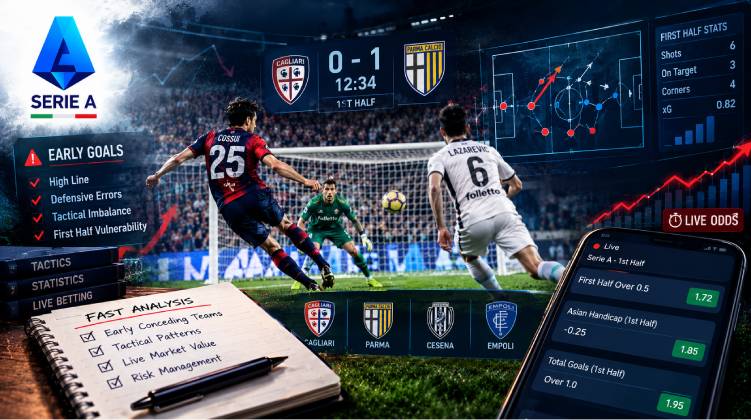
The tactical landscape of the 2014/2015 Serie A season was highly asymmetric, defined by a stark contrast between disciplined, elite defensive units and struggling lower-tier clubs prone to immediate structural collapse. For live match analysts and in-play market readers, this campaign provided highly reliable situational trends, particularly regarding teams that consistently conceded goals within the opening fifteen to thirty minutes of play. When a team demonstrates a chronic inability to settle into a match defensively, it alters the mathematical reality of both the Asian Handicap and Over/Under lines. Capitalizing on these slow starters required a deep understanding of why these defensive systems failed early, and how live market prices lagged behind the real-time tactical deterioration unfolding on the pitch.
The Tactical Anatomy of Slow Starters in Italian Football
Unpacking the structural flaws of clubs that frequently concede early goals requires looking past simple lack of concentration to analyze systemic setup errors. During the 2014/2015 Italian campaign, several relegation-threatened clubs attempted to implement expansive, modern pressing systems without possessing the technical profile or athletic recovery speed required to sustain them. When these teams faced elite opposition or well-drilled counter-attacking sides, their aggressive initial positioning left massive spaces behind their defensive line, which were easily exploited before the central midfielders could establish spatial coverage.
This structural vulnerability was further worsened by a distinct lack of physical intensity during the opening phases of play. Managers often noted that their squads required a significant adjustment period to match the tempo of the game, resulting in early positional errors and mistimed tackles in dangerous areas. For an alert live observer, noticing a team continuously losing second balls in their own defensive third during the first five minutes served as a reliable leading indicator that a first-half defensive breach was imminent.
Identifying the Chronic Early Conceders of the 2014/2015 Campaign
To execute a successful live strategy during this specific season, analysts had to isolate the precise statistical profiles of clubs whose defensive metrics skewed heavily toward early failure. Teams like Parma, dealing with immense off-field financial chaos, and Cagliari, under the ultra-aggressive but defensively reckless philosophy of Zdeněk Zeman, served as textbook examples of squads that regularly found themselves trailing before the match reached the twenty-minute mark.
Quantifying these specific patterns reveals a clear blueprint of structural vulnerability across the division. The following data outlines the defensive performance metrics of selected clubs during the opening thirty minutes of matches throughout the 2014/2015 domestic calendar, highlighting their suitability for targeted first-half in-play strategies.
| Club | Early Goals Conceded (0-30 Mins) | % of Total First-Half Goals | Primary Defensive Failure Mode | Optimal First-Half In-Play Target |
| Cagliari | 24 | 62% | High-line vulnerability in transition | Opposition First Half Team Total Over 0.5 |
| Parma | 22 | 58% | Midfield structural collapse, individual errors | First Half Asian Handicap Fade |
| Cesena | 19 | 55% | Low-block failure under sustained early pressure | Over 1.0 First Half Goal Line |
| Empoli | 15 | 48% | Full-back isolation against elite wingers | Opposition Race to 2 Corners (1H) |
The data detailed above illustrates that certain teams suffered from specific structural deficiencies that made them ideal targets for first-half live positions. Cagliari’s numbers show an extreme vulnerability born out of tactical stubbornness, where their high defensive line was repeatedly punished before the mid-half water break. Interpreting this chart allows an analyst to see that backing an early goal or fading these specific defensive lines was not a speculative gamble, but a calculated position based on highly repeatable, system-driven structural failures.
Mechanics of First-Half In-Play Capitalization
Successfully trading these early defensive collapses required patience, as pre-match lines rarely offered optimal value due to bookmaker risk mitigation models. A professional live reader would deliberately allow the first ten minutes of a match to elapse without taking a position, waiting for the live goal-line or handicap to adjust to a more favorable price. If the target team survived the initial wave of pressure without conceding, the price for a first-half goal would rise significantly, creating an ideal entry point against a defense that was statistically bound to break down.
The Correlation Between Early Defensive Pressures and Live Odds Trajectories
When a heavy favorite fails to score in the first fifteen minutes against a known slow starter, the live market undergoes a rapid pricing shift to protect the bookmaker from public volume. The odds on the favorite’s first-half handicap become increasingly attractive, even though the on-pitch reality shows that the underdog is hanging on by a thread and conceding multiple high-quality chances. Capitalizing on this requires an analyst to accurately measure tracking data—such as box entries, defensive clearances, and corner counts—to confirm that the slow starter’s defensive system is actively fracturing under sustained pressure.
Psychological Cascades of Conceding Early at Home
The impact of an early goal against a struggling team is magnified when they are playing in front of an expectant home crowd. In the 2014/2015 Serie A season, lower-tier clubs playing at home were under immense pressure from their fanbases to show attacking intent from the opening whistle, preventing them from deploying a conservative, ultra-deep defensive block. When this forced aggression resulted in conceding an early goal, the psychological blow often caused an immediate systemic collapse.
Once the away side took an early lead, the home team’s tactical discipline completely dissolved as players threw numbers forward in a panicked attempt to equalize. This chaotic response played directly into the hands of analytical live bettors, as the match state transformed into an open, transition-heavy environment. Fading the recovering home side’s defensive line during the remainder of the first half yielded highly consistent results, as they were repeatedly caught out on the counter-attack while their shape was broken.
How Market Shifting Thresholds Open Value In-Play
Advanced live market interpretation relies heavily on recognizing when public perception and mathematical models diverge during the running of a match. Most automated line-setting algorithms assume a linear distribution of goal probabilities across the ninety minutes, failing to account for the exponential decay of a team’s defensive structure after a specific psychological or tactical threshold is crossed.
When live performance patterns consistently deviate from historical baselines, astute in-play analysts immediately hunt for mathematical discrepancies in the live lines. Observing a team consistently concede before the twenty-minute mark implies that the pre-match handicap is rapidly losing its structural validity, offering sharp live readers a distinct advantage. If a live observer secures an optimal position via a modern sports betting service, they can catch the market before it adjusts to the unfolding defensive collapse. Utilizing the dynamic interface provided by ufabet allows market participants to isolate these first-half defensive deficiencies, converting real-time tactical observation into calculated, strategic execution before the half-time whistle provides the struggling manager a chance to reorganize the defensive block.
Contrasting Risk Management Across Diverse Digital Wagering Environments
The fluid nature of live football markets requires a sharp understanding of how risk is handled across different sectors of the digital gaming industry. While sports markets fluctuate based on human variables, tactical decisions, and psychological pressure, other areas of online gaming operate under entirely static parameters.
Evaluating these fluid, match-driven sports dynamics requires a completely different analytical toolkit compared to evaluating static, algorithmically locked probability tables. For instance, a systematic player navigating a standard online betting site will confront fixed house advantages that rely heavily on automated random generation models. This environment contrasts sharply with a live casino online destination where probabilities are hard-coded and lack the emotional variance of human athletes. In live football markets, conversely, the psychological collapse of a defensive line after an early concession creates a fluid, sentiment-driven pricing structure, allowing intuitive readers to exploit live market panics that simply do not exist in traditional, mathematically insulated gaming systems.
Conditions That Neutralize First-Half Vulnerability
While targeting slow-starting teams in the 2014/2015 season was highly reliable, certain environmental and situational factors could completely neutralize a team’s typical defensive flaws. Assuming a trend will manifest without checking the immediate context of the matchday can lead to severe miscalculations in live execution.
- Severe Adverse Weather Conditions: Heavy rainfall or waterlogged pitches in northern Italy frequently slowed down ball transition speeds, preventing elite teams from exploiting an underdog’s high defensive line.
- Radical Lineup Rotations: If an elite opponent rested their primary creative wingers ahead of a Champions League fixture, the slow-starting underdog faced far less creative pressure during the opening thirty minutes.
- Early Defensive Tactical Adjustments: A manager opting for an ultra-conservative five-back formation specifically to counter an early-season trend completely altered the team’s typical vulnerability profile.
- Mid-Week Physical Fatigue: Teams playing their third match in seven days lacked the physical energy to exploit early gaps, causing matches to start at a much slower pace.
Analyzing these exceptions shows that a blind trend-following strategy will eventually fail when confronted with shifting real-world variables. The underlying trend of early concessions is only valid if the opposing team possesses the specific tactical tools and physical fitness required to force the error.
Summary
The propensity of specific 2014/2015 Serie A teams to concede early goals created a highly predictable environment for first-half live betting strategies. Systemic flaws such as Zeman’s overly aggressive high line at Cagliari or Parma’s midfield structural collapse offered clear signals for sharp live readers to exploit. By waiting for live markets to adjust and pricing variations to open up, analysts could bypass inflated pre-match lines and maximize value, proving that deep tactical awareness remains the ultimate edge over automated bookmaker algorithms.